Some links in this piece are affiliate links. If you buy something through one, Little Home Details may earn a small commission, at no extra cost to you. It never changes what ends up in the drawer. How this works.
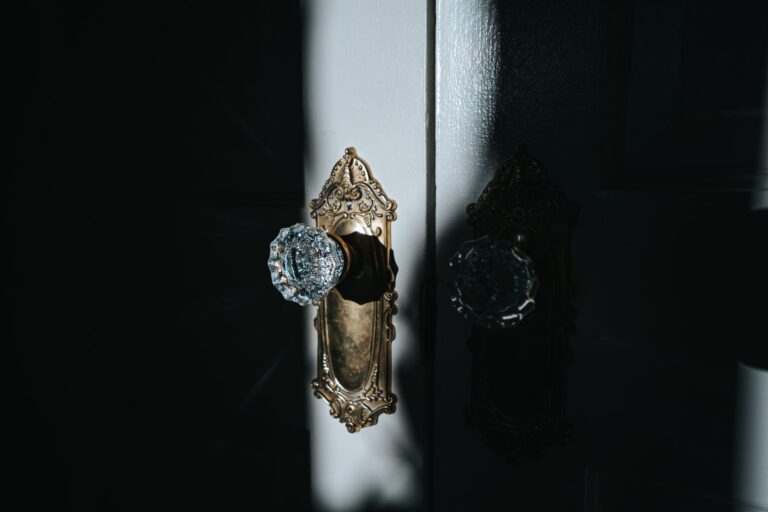
The glass doorknob on the bedroom at the end of the hall came with the house, original as far as anyone can tell, and it has a worn patch on one facet that no longer catches light the way the rest of the knob does. It sits just off center, slightly lower than where you would expect a palm to land, which took me a while to understand until I realized most people who lived here before us were probably a few inches shorter, or simply gripped it differently, lower on the knob, fingers curled rather than palm flat.
Glass knobs like this one are faceted, cut like a gem into six or eight flat panels so that light breaks apart differently depending on the angle you view it from. New ones, the reproductions you can order today, are cut with a uniform clarity, every facet catching the same crisp glint. This one does not. The worn facet has gone slightly cloudy, the surface texture softened at a microscopic level by however many thousand hands have turned it since it was installed, probably sometime in the early part of the last century judging by the backplate style.
Taking It Apart
I took the knob off last spring to clean behind it, expecting nothing more than dust. Instead I found the mechanism inside had been repaired at some point with a mismatched screw, slightly too long, filed down at the tip so it would not protrude through the other side. Whoever did that repair took real care with it. It would have been easier to just replace the whole knob, and glass knobs were not especially expensive even decades ago. Someone chose to keep this exact one working instead.
Behind the rosette, wedged into the gap between the wood and the mechanism, was a scrap of newspaper, yellowed and brittle, folded into a small square, clearly used as a shim to stop a rattle. I could make out part of a date on it, though not enough to be certain of the year, and a fragment of a headline about a school board vote. I did not remove it. It seemed like a strange thing to disturb, a scrap of someone else’s ordinary Tuesday, folded up and tucked into a door for no reason except that the door was loose and the newspaper was within reach.
The Weight of Glass Versus the Weight of Brass
Glass knobs feel different in the hand than any metal one. They carry a cold that lingers a beat longer before warming to skin, and a smoothness that never quite develops the same kind of grip texture that a cast metal knob picks up with age. Where a brass knob darkens and tarnishes and tells its history in color, a glass knob tells it in wear you can only see by turning it in the light, looking for the one facet that has gone soft.
An antique dealer once told me that a genuinely old glass knob will have exactly one worn facet, never two, because people are creatures of habit and will grip a doorknob the same way every single time for forty years without ever noticing they are doing it.
I tested this on every glass knob in the house after she said it, turning each one slowly under the hall light, and she was right every time. The one worn spot is always slightly lower than center on interior doors, and slightly higher on the doors that lead outside, which I think has to do with pushing a door open with an armload of groceries versus pulling one shut gently from a seated hallway habit of reaching without looking.
Why I Have Not Replaced It
I could buy a matching reproduction knob for less than the cost of dinner out, and for a while I planned to, mostly because the worn facet bothered me in photographs, catching the light strangely and looking, in pictures, like a flaw rather than a feature. In person it never bothers me. It only shows itself when you turn the knob slowly, deliberately, the way you would if you were paying attention rather than simply walking through a doorway on the way to somewhere else.
I think what stopped me, in the end, was the newspaper shim. Once I had seen it, I could not think of the doorknob as separate from the house’s longer life, the version of it that existed before we bought it, full of people I will never meet who were annoyed by a rattling door on some ordinary evening and solved it with whatever was on the kitchen table. Replacing the knob would not erase that. But keeping it means I get to touch, every single day, the same worn facet that someone else’s hand wore smooth first, gripping it low and to the left, the same way, thousands of times, without ever once thinking about it.
A Small Kind of Company
Some mornings, half asleep, reaching for that door before the coffee has kicked in, I catch my hand landing on the worn spot without meaning to, and there is something quietly companionable in that, sharing a habit with someone I will never know, whose name is not on any paperwork I have ever seen for this house, but whose hand, in some small physical sense, is still in the room with me every time I turn that knob.