Some links in this piece are affiliate links. If you buy something through one, Little Home Details may earn a small commission, at no extra cost to you. It never changes what ends up in the drawer. How this works.
There is a particular sound a stack of plates makes when the top one does not sit quite flush, a faint rock and click rather than the solid, dull thud of plates settling flat against each other. I hear it almost every evening while I dry dishes, and over the years I have learned to tell, without looking, which plate in the cabinet is the culprit just from the pitch of that click.
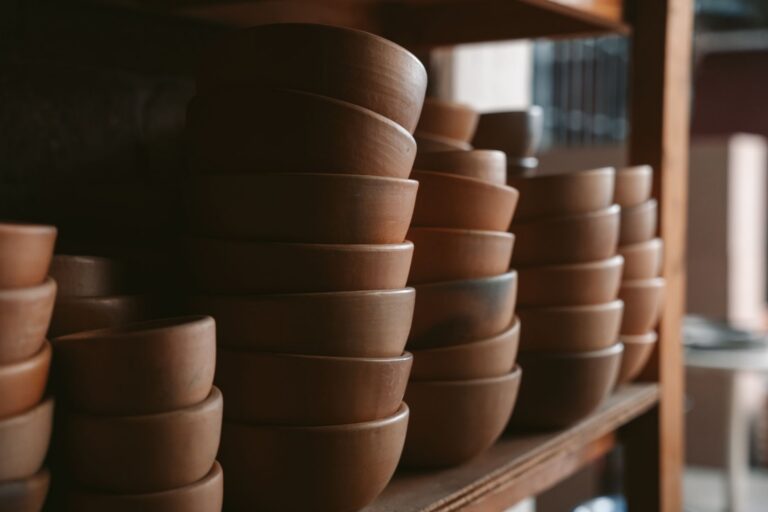
Most of our everyday plates are wide and slightly rimmed, and they stack cleanly, rim resting into rim, base into base, with almost no wobble even six or seven high. But there is one bowl, a shallow pasta bowl with a wide flat rim, whose foot ring is very slightly off center, a flaw so small you would never catch it by eye, and every time it lands on top of the stack it rocks a fraction of an inch before settling, tapping once, sometimes twice, against the bowl below it.
Where the wear actually happens
Stacking is one of those daily habits that seems too small to matter until you look closely at where the wear collects. The rims of our plates, the outer edge that touches the plate below or above it in the cabinet, have gone slightly duller than the centers, a faint ring of thinned glaze that traces exactly where plate meets plate several times a day, every day, for years. Run a finger around the rim of any of our most used plates and you can feel the glaze there is marginally smoother, worn down by nothing more dramatic than contact with its own kind.
The pasta bowl with the off-center foot has left its own small mark too, a scatter of tiny gray scuffs along the rim of the bowl beneath it, each one a fraction of a millimeter, invisible unless the light rakes across the glaze at a low angle in the evening. None of this damage would show up in a photograph. It only shows up to a hand that knows the dish well enough to notice.
My mother, visiting last spring, stacked the dishes differently than I do, plates one way and bowls another, and the whole cabinet made a different sound while she worked. I noticed it before I noticed anything else about how she had rearranged the kitchen.
Ceramic against ceramic
People talk about protecting glassware with felt pads or paper towels between stacked plates, and we do that for a few pieces, mostly the ones that came from my grandmother’s set and that I am more careful with than the rest. But most of our everyday ceramic goes directly into the cabinet, plate against plate, bowl against bowl, with nothing between them, and that direct contact is exactly what produces both the dulled rims and the particular sounds each stack makes.
I have come to think the sound itself is a kind of information, separate from anything visual. A stack that settles with one solid, low click is a stack of plates whose curvature matches closely enough to sit flush. A stack that clicks twice, unevenly, tells you something in that pile does not quite belong there, a slightly different width or a warped rim from an uneven firing. I can often identify which specific bowl has been returned to the wrong stack just from the sound of the next one landing on top of it.
What changes when you actually listen
For a long time I did not pay any attention to this at all. Drying dishes was just drying dishes, something to get through quickly on the way to the next task. It was only after months of doing it slowly, without the radio on, that I started to notice the differences in sound between one stack and another, and once I noticed, I could not stop noticing.
Now when I put dishes away I sometimes pause on a particular click, turn the bowl over, and look for the flaw that produced it. Usually it is something tiny, a slightly thicker glaze pool on one side of the foot ring, or a foot that was trimmed at a faint angle rather than perfectly level. These are the kinds of imperfections a factory-made set is designed to eliminate entirely, and a handmade set, however skilled the potter, will always carry a few of, scattered quietly through an otherwise ordinary stack of plates.
I do not think this makes the dishes worse. If anything, it gives the ordinary chore of putting them away a small, specific texture it would not otherwise have, a set of sounds I have come to recognize the way you recognize a particular creak in a stair.