Some links in this piece are affiliate links. If you buy something through one, Little Home Details may earn a small commission, at no extra cost to you. It never changes what ends up in the drawer. How this works.
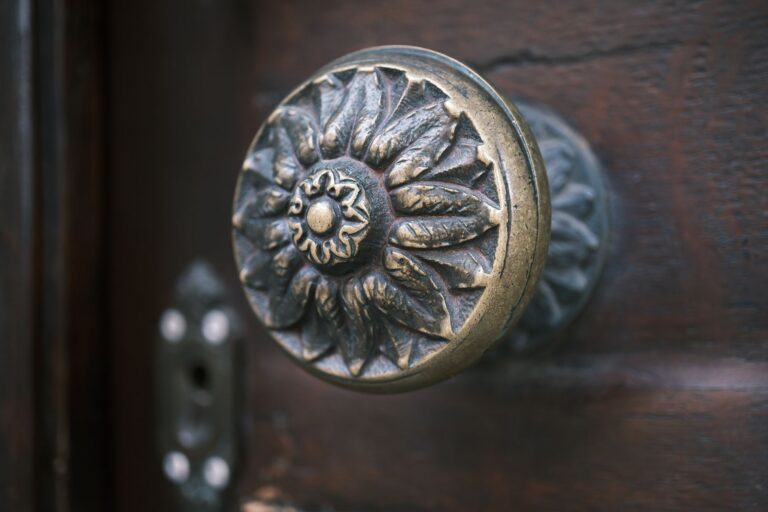
I pulled every hinge and pull off the built-in cabinet in the dining room last spring, laid them out on an old towel on the kitchen counter, and could not quite believe how much tarnish had accumulated on pieces I had walked past for years without really looking at. The brass had gone almost black in the recesses of the decorative scrollwork, the kind of darkening that happens slowly enough you never catch it happening, only notice the result once the piece is out of context, sitting under a bright kitchen light instead of tucked into a dim corner of the dining room.
The soak itself is unglamorous. White vinegar in a glass dish, enough to cover the pieces, a spoonful of salt stirred in, and then waiting, checking every twenty minutes or so, fishing a hinge out with a fork to see how the tarnish is lifting. Some pieces came clean in under an hour. One stubborn pull, the one from the cabinet closest to the radiator, sat in the solution for nearly three hours and still needed a soft brass brush afterward to work the last of the black out of the detailing.
Deciding How Clean Is Too Clean
About halfway through the soaking, I had to stop and think about what I actually wanted these pieces to look like when I was done. Vinegar and salt, given enough time, will take a piece of old brass almost back to raw, bright metal, closer to how it looked the day it left whatever factory made it, probably decades before this house was even built. That brightness looked almost wrong sitting next to the aged wood of the cabinet, too new, too loud, like a freshly painted fence in an otherwise weathered yard.
I pulled several pieces out early, before they went fully bright, leaving a soft patina in the recesses of the scrollwork where the brush could not easily reach anyway. That uneven cleaning, bright on the raised surfaces and darker in the grooves, is actually closer to how old hardware is meant to look when it has been cared for over decades rather than neglected and then suddenly restored. A jeweler I mentioned this to later told me that is exactly the effect professional platers aim for when they clean antique pieces, deliberately leaving darkness in the recesses so the detail still reads clearly from a distance.
The Foundry Mark
Underneath one of the hinges, on the inside face that never sees light once it is installed, I found a small stamped mark, a shield shape with initials inside it, worn but legible once the tarnish came off. I have not been able to identify the foundry, though I spent longer than I care to admit searching for it, comparing photographs of old hardware catalogs online. It does not matter much whether I ever find out. What mattered was noticing it existed at all, a tiny signature from whoever cast this hinge, meant to be seen by no one, hidden inside a cabinet in a dining room a hundred years and probably several owners away from wherever it was made.
An old hardware dealer once told me that the marks foundries stamped on the inside of hinges were rarely meant as decoration. They were mostly for the foreman on the shop floor, a way to track which batch had come from which mold in case of a defect. It is strange to think a mark made for quality control has outlived every person who ever needed it for that purpose.
Putting It Back Together
Reinstalling cleaned hardware is its own small satisfaction, mostly because everything goes back exactly where it came from if you are careful to keep pieces from different cabinets sorted separately. I learned this the slightly hard way on an earlier project, mixing up screws from two similar but not identical hinges, only to find one set was a hair too long and pushed slightly through the far side of the wood. Now I keep pieces in small labeled containers during any soak, an unglamorous habit that has saved me at least two return trips to the hardware store.
The dining room cabinet looks noticeably different now, not gleaming, but present in a way it was not before, the scrollwork actually visible instead of lost in a general darkness that read, at a glance, as simply old rather than detailed. Guests have commented on it exactly once, which is probably the right amount of attention for hardware to get. It is not meant to be the thing anyone notices first. It is meant to hold up its small part of the room quietly, and only reward a closer look.
What the Soak Does Not Fix
Vinegar will lift tarnish, but it will not straighten a bent hinge leaf or fill in a stripped screw hole, and I had to accept that two of the older pieces, despite coming out beautifully clean, still have a slight wobble that no amount of soaking will solve. I put them back anyway. A little wobble in a hundred-year-old hinge feels like a fair trade for everything else it has held up without complaint for that long.